

Image Details
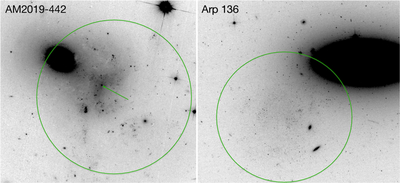
Caption: Figure 15.
Zoomed, high-contrast views of two foreground low surface brightness dwarfs (left: AM2019-442, previously identified by J. Yadav et al. 2022; right: Arp 136) partially superimposed on background early-type galaxies whose morphologies and sizes suggest much larger distances, and thus no true physical association. Both foreground dwarfs have resolved point-source populations indicative of recent star formation, centered on a smooth, but low surface brightness, background of older stars. Open green circles indicate the approximate extent of the recent star formation in each galaxy, and the green arrow indicates a possible nuclear cluster candidate centered on the smooth background of older stars in AM2019-442’s foreground dwarf. The higher density and degree of clustering of point sources in the AM2019-442 dwarf suggest a higher SFR intensity than in the Arp 136 system. Notably, there is a rich network of structured dust obscuration against the background galaxy in AM2019-442, which suggests that this might be a favorable system for studying the cold ISM in a low surface brightness galaxy.
Other Images in This Article
Show More
Copyright and Terms & Conditions
© 2026. The Author(s). Published by the American Astronomical Society.

