

Image Details
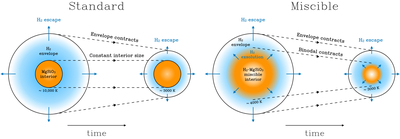
Caption: Figure 1.
Schematic showing the thermal and atmospheric escape evolution of two interpretations of sub-Neptune interiors. In a standard planetary model, a silicate interior is distinct from a hydrogen-rich envelope. As the planet contracts, hydrogen is removed from the upper atmosphere via stellar heating, and the interior-envelope boundary does not significantly contract with time. The temperature at this interface can reach of order ∼10,000 K at early ages. In the miscible model, the interior-envelope boundary is defined by a binodal surface, which delineates regions in which hydrogen and silicate are miscible or immiscible. The temperature at the binodal surface does not change significantly with time. The radial position of the binodal surface contracts with time, exsolving hydrogen into the base of the envelope, while hydrogen is also removed from the top of the upper atmosphere.
Other Images in This Article
Copyright and Terms & Conditions
© 2026. The Author(s). Published by the American Astronomical Society.

