

Image Details
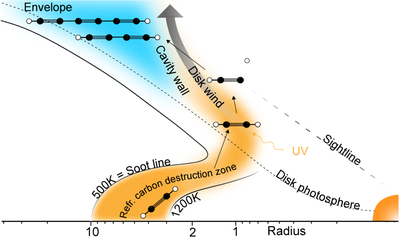
Caption: Figure 3.
Proposed scenario to explain the hydrocarbon-rich spectrum of HOPS-68. Gas-phase carbon-bearing species enrich the gas between the soot line (∼500 K) and the graphite sublimation rim (∼1200 K), which we refer to as the "refractory carbon destruction zone," and are then entrained and transported out of the disk by the disk wind. In the outflow cavity, C2H2 reacts with UV photons, with C2H as the reaction product. C2H can react with C2H2 to form carbon-chain species such as C4H2 and C6H2. The locations of the isotherms were estimated using the results from Paper A.
Other Images in This Article
Copyright and Terms & Conditions
© 2026. The Author(s). Published by the American Astronomical Society.

Copyright ©
2026 Astronomy Image Explorer. All Rights Reserved.
