

Image Details
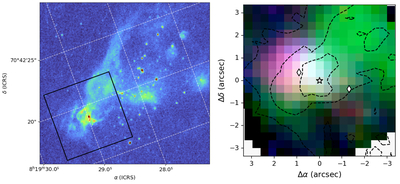
Caption: Figure 1.
Left panel: HST/WFC F502N image of the Holmberg II nebula, covering approximately 15″ × 15″ (1″ ≃ 16.5 pc at 3.4 Mpc). The black box (6″ × 6″) is centered on the ULX Ho II X–1 and indicates the region displayed in the right panel. The color scale shows the relative F502N intensity in arbitrary units to illustrate the optical nebular morphology. Right panel: JWST/MIRI MRS red, green, and blue map of the Ho II X–1 nebula, expressed in offset celestial coordinates from the ULX position (referred to as the XS region using a star symbol). Green: the [S III] ∼18.7 μm emission. Red: [Ne V] ∼14.3 μm. Blue: [O IV] ∼25.9 μm emission. Each surface-brightness map was normalized to its peak intensity and PSF-matched to the MIRI MRS Channel 4 spatial resolution, filtering out spaxels with SNR < 3. Black dashed contours show the HST/WFC F502N surface brightness at the 95th, 99th, and 99.7th percentile levels emission of Ho II X–1, smoothed with a Gaussian filter of ﹩0\mathop{.}\limits^{{\prime\prime} }25﹩ width to suppress small-scale fluctuations. Diamond markers indicate the centroids of the NE and SW radio knots.
Other Images in This Article
Copyright and Terms & Conditions
© 2026. The Author(s). Published by the American Astronomical Society.

