

Image Details
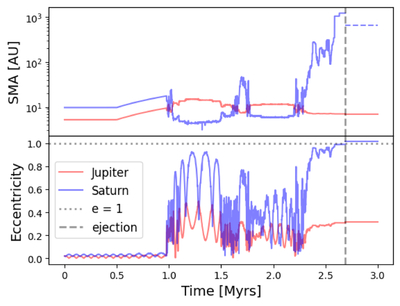
Caption: Figure 3.
Example evolution of a two-planet system undergoing a WD kick. Shown is the orbital evolution of the SMAs (upper frame) and eccentricities (lower frame) of a Jupiter-like (red lines) and Saturn-like (blue lines) planet orbiting a solar-type star, as modeled using REBOUND. The orbits are initially nearly coplanar and circular, and are dynamically stable. The orbits remain stable throughout the red giant branch (RGB) mass-loss phase (starting at about 0.5 Myr in the simulation; the mass-loss phase is sped up compared to a realistic stellar evolution simulation to reduce computation time), but a 1 km s−1 strong WD kick at the end of the RGB phase (at about 1 Myr) majorly alters the planetary orbital SMAs and eccentricities, triggering instability. Over the course of the next ∼2 Myr, the planets undergo repeated scattering encounters, until the outer Saturn-like planet is ejected, becoming an FFP (moment of ejection marked with gray dashed line). The SMA of the ejected planet is about −670 au (shown by the blue dashed line, as an absolute value due to the logarithmic y-axis), implying an excess ejection velocity of about 0.85 km s−1.
Other Images in This Article
Copyright and Terms & Conditions
© 2026. The Author(s). Published by the American Astronomical Society.

