

Image Details
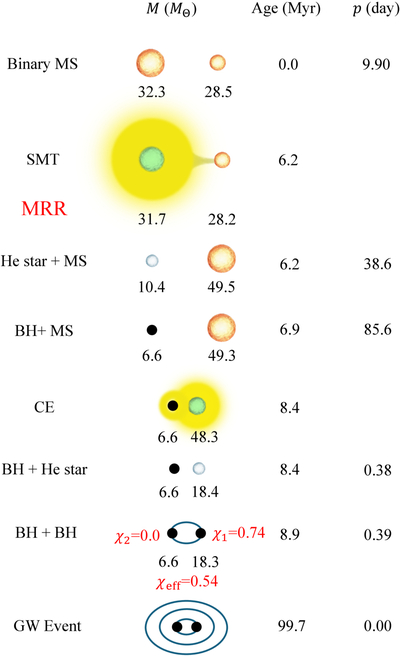
Caption: Figure 1.
Representative evolutionary pathway of the MRR channel leading to the formation of a GW241011-like event with χ1 = 0.74. The system undergoes stable Roche-lobe overflow initiated by the initially more massive star, resulting in MRR. The initially less massive star later initiates a CE phase, whose ejection dramatically reduces the orbital separation. Following the CE phase, strong tidal interactions spin up the He-star progenitor of the second-born BH. The subsequent core collapse gives rise to a rapidly rotating BH, and the resulting BBH merges via gravitational-wave emission after a delay time of 99.7 Myr. The underlying population adopts the fiducial mass-transfer prescription, lognormally distributed natal kicks with (μ = 5.6) and (σ = 0.68), and αCE = 5.
Other Images in This Article
Copyright and Terms & Conditions
© 2026. The Author(s). Published by the American Astronomical Society.

