

Image Details
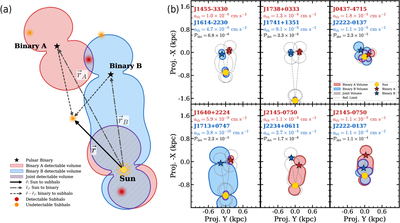
Caption: Figure 1.
Geometric configuration and effective detection volumes for joint subhalo detection by binary pulsars. Left panel: detection method. The red and blue shaded regions represent the detectable volumes of Binary A and Binary B, respectively, while the purple shading shows their overlapping joint detectable volume. Red dots indicate detectable subhalos, while orange dots indicate undetectable subhalos. Right panels: detection geometry for the six neighboring binary pulsar pairs. Red and blue regions show the sensitivity lobes of each pulsar to a 107 M⊙ subhalo under current precision, and purple regions mark the joint detectable volumes. Yellow dots denote the Sun, and red/blue stars denote the two pulsars. Gray dotted contours indicate the reference detection regions for an ideal acceleration sensitivity of 10−9 cm s−2. The acceleration thresholds and corresponding joint detection probabilities are labeled in each panel.
Other Images in This Article
Copyright and Terms & Conditions
© 2026. The Author(s). Published by the American Astronomical Society.

