

Image Details
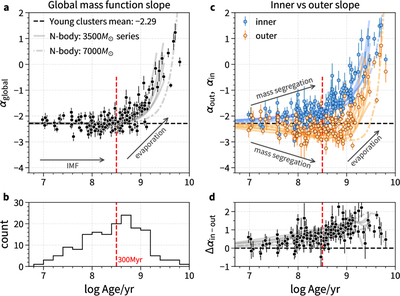
Caption: Figure 1.
Evolution of the stellar mass function of observed open clusters. (a) The global mass function slope (αglobal) as a function of age for 163 open clusters (black points). Young clusters (<300 Myr) show a tight distribution around the mean α = −2.29 (black dashed line) with an intrinsic scatter of 0.17 (after correcting for measurement uncertainties), indicating a nearly universal initial condition consistent with the canonical Salpeter slope α = −2.35. A distinct upturn (flattening) due to tidal evaporation (preferential loss of low-mass stars) becomes evident only after ∼600 Myr. (b) The age distribution of the sample, covering the full evolutionary range from the onset of the gas-free phase to dissolution. (c) Differential evolution of the mass function slope in the inner (blue, inside the half-number radius r50) and outer (orange) regions. (d) The degree of mass segregation, Δα = αin − αout. Mass segregation is minimal at an age of ∼10 Myr but increases steadily thereafter, driven by rapid internal relaxation. Overlaid in panels (a), (c), and (d) are evolutionary tracks from direct N-body simulations initialized with a Kroupa IMF and no primordial mass segregation (solid pale curves, color-coded to match data: initial mass of 3500M⊙; dotted–dashed: 7000M⊙), which reproduce the observed timescales for segregation and evaporation.
Other Images in This Article
Copyright and Terms & Conditions
© 2026. The Author(s). Published by the American Astronomical Society.

