

Image Details
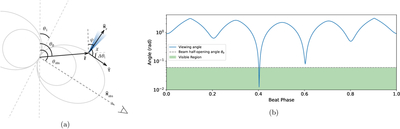
Caption: Figure 1.
(a) Schematic illustration of the emission geometry. The emission beam is centered on ﹩{\hat{{\boldsymbol{n}}}}_{e}﹩, which is characterized by the specific angle χ. ﹩{\hat{{\boldsymbol{n}}}}_{\,\rm{obs}\,}﹩ denotes the observer’s line of sight. (b) A fiducial example, motivated by J1634-like timing properties, showing the viewing angle ﹩{\rm{\arccos }}({\hat{{\boldsymbol{n}}}}_{e}\cdot {\hat{{\boldsymbol{n}}}}_{\,\rm{obs}\,})﹩ as a function of beat phase. The green-shaded region represents the visible condition, i.e., ﹩{\rm{\arccos }}({\hat{{\boldsymbol{n}}}}_{e}\cdot {\hat{{\boldsymbol{n}}}}_{\,\rm{obs}\,})\lt {\theta }_{\,\rm{beam}\,}﹩, where θbeam is the beam half-opening angle. In this case, only one minimum lies within the visibility window during each beat cycle, producing a single-burst pattern.
Other Images in This Article
Copyright and Terms & Conditions
© 2026. The Author(s). Published by the American Astronomical Society.

