

Image Details
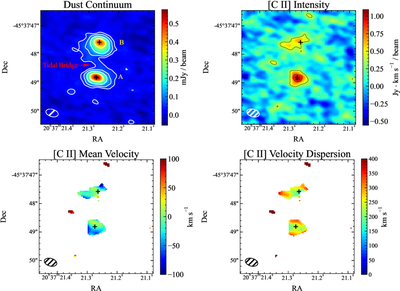
Caption: Figure 1.
The ALMA observation of J2037–4537. The images are cleaned with natural weighting. The cleaned beam has sizes of ﹩0\mathop{.}\limits^{^{\prime\prime} }44\times 0\mathop{.}\limits^{^{\prime\prime} }26﹩, demonstrated by the hatched ellipses. The black crosses mark the optical positions of the quasars as measured by previous Hubble Space Telescope imaging (M. Yue et al. 2021). Upper left: the FIR continuum. The white lines mark 2σ, 4σ, 8σ, and 16σ contours. We denote the southern object as Quasar A and the northern one as Quasar B. Upper right: the integrated [C II] intensity (the moment 0 map). The black lines mark 2.5σ and 5σ contours. The continuum exhibits tidal bridges between the two quasars, confirming that J2037–4537 is a physical quasar pair residing in an ongoing galaxy merger. Lower left: the [C II] velocity field. Lower right: the [C II] velocity dispersion map. For the lower panels, we only show pixels with signal-to-noise ratio (S/N) > 2.5 in the [C II] moment 0 map. Quasar B exhibits irregular structures indicative of tidal disruption. The velocity gradient for both quasars is much smaller than their velocity dispersions, indicating that both quasars are dispersion-dominated.
Other Images in This Article
Copyright and Terms & Conditions
© 2026. The Author(s). Published by the American Astronomical Society.

