

Image Details
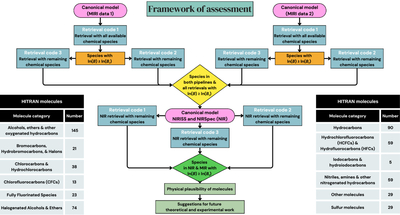
Caption: Figure 1.
The flowchart shows our framework of assessment for possible molecules in the atmosphere of K2-18 b. Based on the inference of carbon dioxide (CO2) and methane (CH4) in the atmosphere of K2-18 b (M23), retrievals adopting canonical models are carried out following M25, assuming hydrogen-dominated atmospheres and including the mixing ratios of CO2, CH4, and X as free parameters, with X in this work being any of 661 species explored. The evidence for X is then computed by performing a Bayesian comparison between the relevant canonical model and a nested baseline model, with only X removed. Several independent retrieval codes can be used to increase the reliability of such a framework. In this work, retrieval codes 1, 2, and 3 are POSEIDON, VIRA, and pRT, respectively. Retrievals were initially performed with the POSEIDON retrieval code on the two available MIRI datasets for K2-18 b, resulting from the JExoRES and JexoPipe data reduction pipelines (MIRI data 1 and 2, in the pink curved boxes at the top left and top right). Nearly all molecules in the HITRAN cross-section database were used in these initial retrievals, as shown in the tables on the lower left- and lower right-hand sides of the figure. Additionally, some other available molecules, as well as atoms and ions, were considered, where originally included in POSEIDON. A threshold Bayes factor ﹩\mathrm{ln}{B}_{T}﹩ is chosen, and chemical species for which ﹩\mathrm{ln}B\geqslant \mathrm{ln}{B}_{T}﹩ is found are identified (orange rectangles), and follow-up retrievals are performed with VIRA and pRT. Chemical species for which ﹩\mathrm{ln}B\geqslant \mathrm{ln}{B}_{T}﹩ is found across both reduction pipelines and all three retrieval frameworks (yellow diamond) are passed to the next step, where we include them in atmospheric retrievals on the NIR data from the NIRISS and NIRSpec JWST transits (pink curved box in the middle) of K2-18 b (M23). Finally, retrievals with VIRA, pRT, and POSEIDON are used to find if there are species for which ﹩\mathrm{ln}B\geqslant \mathrm{ln}{B}_{T}﹩ can be reached in the NIR data (green diamond). We then discuss the physical plausibility of promising species being present in the atmosphere of K2-18 b. In this work, we chose ﹩\mathrm{ln}{B}_{T}=2.0﹩. This is informed by the threshold ﹩\mathrm{ln}B=2.5﹩ for moderate evidence proposed by R. Trotta (2008), and accounting for possible systematic uncertainties of up to ±0.5 on the estimation of ﹩\mathrm{ln}B﹩, as discussed in Section 3.2.1.
Other Images in This Article
Copyright and Terms & Conditions
© 2026. The Author(s). Published by the American Astronomical Society.

