Image Details

Choose export citation format:

AT2025ulz and S250818k: Leveraging DESI Spectroscopy in the Hunt for a Kilonova Associated with a Subsolar-mass Gravitational-wave Candidate

  • Authors: Xander J. Hall, Antonella Palmese, Brendan O'Connor, Daniel Gruen, Malte Busmann, Julius Gassert, Lei Hu, Ignacio Magaña Hernandez, Jessica Nicole Aguilar, Ariel Amsellem, Steven Ahlen, John Banovetz, Segev BenZvi, Davide Bianchi, David Brooks, Francisco Javier Castander, Todd Claybaugh, Andrei Cuceu, Arjun Dey, Peter Doel, Jennifer Fabà-Moreno, Simone Ferraro, Andreu Font-Ribera, Jaime E. Forero-Romero, Gaston Gutierrez, Laurent Le Guillou, Dick Joyce, Theodore Kisner, Anthony Kremin, Ofer Lahav, Claire Lamman, Martin Landriau, Michael Levi, Axel de la Macorra, Marc Manera, Aaron Meisner, Ramon Miquel, John Moustakas, Seshadri Nadathur, Francisco Prada, Ignasi Pérez-Ràfols, Graziano Rossi, Eusebio Sanchez, David Schlegel, Michael Schubnell, David Sprayberry, Gregory Tarlé, Benjamin Alan Weaver, Rongpu Zhou, Hu Zou

Xander J. Hall et al 2026 The Astrophysical Journal Letters 1001 .

  • Provider: AAS Journals

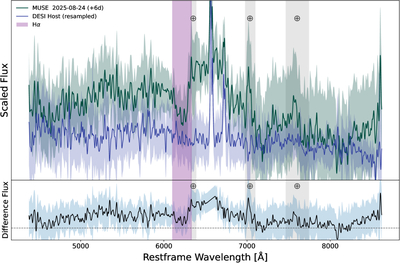
Caption: Figure 5.

MUSE spectrum of AT2025ulz reported by S. Banerjee et al. (2025a) and DESI host spectrum of AT2025ulz. The MUSE spectrum classifies AT2025ulz as a Type IIb SN. The top panel shows both spectra normalized by their median flux while the bottom panel shows the MUSE spectrum with the DESI spectrum subtracted. Tellurics are denoted with ⊕ and the Hα and N II complex is masked out in the subtraction. A clear P Cyg Hα shape can be seen.

Other Images in This Article
Copyright and Terms & Conditions

Additional terms of reuse