

Image Details
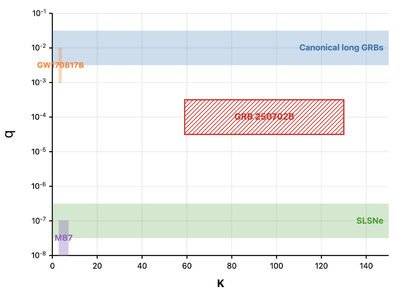
Caption: Figure 3.
Qualitative placement of GRB 250702B (shaded rectangle) in (K, q) space, where K ≡ r/rISCO(a*) and q ≡ MT/MBH is the torus-to-BH mass ratio (M. H. P. M. van Putten et al. 2024). For the observed period P ≃ 2825 s and a fiducial MBH = 6 M⊙, GRB 250702B occupies K ≃ 59–130 for BH spins a* = 0.5–0.9 and q ∼ 10−4 (shaded band). The adopted q value places the event between canonical long GRBs (q ∼ 10−2) and SLSNe (q ∼ 10−7). The rectangular boxes show representative (K, q) regions for GW170817B (the post-merger BH spindown signal associated with GW170817 with estimated K ∼ 3–4 and q ∼ 10−3–10−2; M. H. P. M. van Putten et al. 2024) and M87 with minimal torus fraction q ∼ 10−7–10−8 (jet launching and collimation occur on scales of a few rISCO, inferred from VLBI constraints and jet kinematics—e.g., S. S. Doeleman et al. 2012; F. Mertens et al. 2016; J. Y. Kim et al. 2018; and further supported by the detection of jet precession—e.g., Y. Cui et al. 2023). Both GW170817B and M87 therefore anchor the “few–rISCO” end of the diagram, whereas GRB 250702B requires a much larger K, where the precession is set by the outer working annulus of a thick inner flow.
Other Images in This Article

Copyright and Terms & Conditions
© 2025. The Author(s). Published by the American Astronomical Society.

