

Image Details
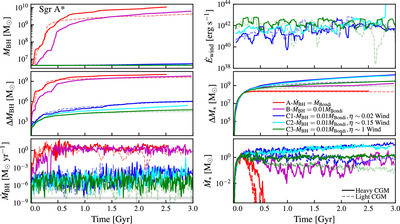
Caption: Figure 2.
Results for the Sgr A* analog runs: the BH mass; AGN wind energy flux (averaged over 100 Myr); net increase in BH mass; net stellar mass, along with the corresponding BH accretion rates and star formation rates for Runs A (red curves), B (magenta curves), C1 (purple curves), C2 (blue curves), and C3 (green curves). The gray shaded region marks the BH accretion rate estimated EHT data (Event Horizon Telescope Collaboration et al. 2022). Without AGN feedback, both Runs A and B exhibit runaway BH growth, leading to rapid growth by orders of magnitude that occurs due to the accretion of gas that would have otherwise formed stars, thereby significantly lowering the star formation rate. The higher the feedback efficiency, seen in Runs C1, C2, and C3, the lower the corresponding BH accretion rate and star formation rate. A feedback efficiency of η ∼ 1 (Run C3) or η ∼ 0.02 (Run C1), assuming missing baryons) is required to suppress the star formation rate to ≲2M⊙ yr−1 (e.g., L. Chomiuk & M. S. Povich 2011; T. C. Licquia & J. A. Newman 2015; D. Elia et al. 2022). A feedback efficiency of ∼1, combined with a low CGM mass (gray dashed line) and missing baryons, is likely necessary to maintain a BH accretion rate that is consistent with the EHT data for an extended period.
Other Images in This Article
Copyright and Terms & Conditions
© 2025. The Author(s). Published by the American Astronomical Society.

