

Image Details
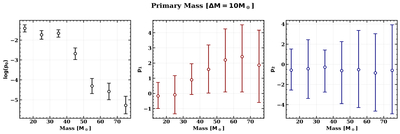
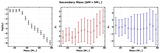
Caption: Figure 2.
Posterior constraints on the redshift evolution of the BBH primary-mass (m1) distribution for a binning scheme with ΔM = 10 M⊙ and Δz = 0.1. Left: constant coefficient ﹩\mathrm{log}{p}_{0}﹩ describing the baseline primary-mass distribution. Middle: linear coefficient p1, quantifying the first-order variation of the mass distribution with redshift. Right: quadratic coefficient p2, probing possible curvature in the redshift dependence. Error bars represent 1σ credible intervals obtained from the hierarchical Bayesian analysis. The linear coefficient is consistent with zero at low masses (m1 ≲ 30 M⊙) and shows a mild positive trend toward higher masses, suggesting that more massive black holes may be relatively more abundant at earlier cosmic times. The quadratic coefficient remains consistent with zero across all mass bins, indicating that a linear redshift dependence adequately describes the population within the current observational range z ≲ 1 accessible to LVK.
Other Images in This Article
Show More
Copyright and Terms & Conditions
© 2026. The Author(s). Published by the American Astronomical Society.

