

Image Details
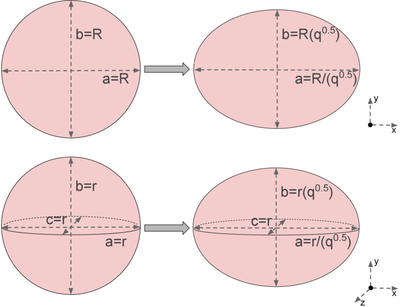
Caption: Figure 2.
Illustration of the deformation. Top: 2D projection with surface density transformation ﹩{\rm{\Sigma }}(\sqrt{{x}^{2}+{y}^{2}})\to {\rm{\Sigma }}(\sqrt{q{x}^{2}+{y}^{2}/q})﹩. The isodensity contour changes from a circle to an ellipse with axis ratio ﹩a:b=1/\sqrt{q}:\sqrt{q}﹩. For convenience of calculation, we choose the a- and b-axes to be oriented along the x- and y-axes, respectively. Since the transformation has a Jacobian determinant of unity, the enclosed area and mass are preserved. Bottom: effective 3D structure with density transformation ﹩\rho (\sqrt{{x}^{2}+{y}^{2}+{z}^{2}})\to \rho (\sqrt{q{x}^{2}+{y}^{2}/q+{z}^{2}})﹩. The c-axis is aligned with the LoS (i.e., the z-axis). The a- and b-axes are also aligned with the x- and y-axes, respectively. Here, the isodensity shell changes from a sphere to an ellipsoid (triaxial model) with axis ratios ﹩a:b:c=1/\sqrt{q}:\sqrt{q}:1﹩. The transformation again has a Jacobian determinant of unity, preserving the enclosed volume and mass. The top structure is the projection of the bottom structure. The mass and shape of the ellipsoid provide an effective representation of the halo.
Other Images in This Article

Show More
Copyright and Terms & Conditions
© 2026. The Author(s). Published by the American Astronomical Society.

