

Image Details
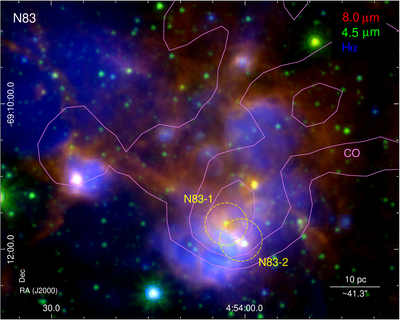
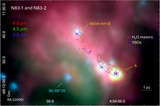
Caption: Figure 1.
Three-color composite image of the N 83 star-forming region combining the Spitzer/SAGE IRAC 8.0 μm (red), 4.5 μm (green; M. Meixner et al. 2006), and MCELS Hα (blue; R. C. Smith & MCELS Team 1998) images. The magenta contours correspond to the single-dish 12CO (J = 1–0) emission from the Magellanic Mopra Assessment (MAGMA) survey with an effective angular resolution of ∼45″ (for comparison, an angular resolution of the Spitzer images is ∼2″), with contour levels of (20, 40, 70)% of the 12CO integrated intensity peak of 14.8 K km s−1 (T. Wong et al. 2011). The ALMA fields (true to size) are indicated with dashed yellow circles and labeled; they are located in the Hα nebula N 83A (K. G. Henize 1956). The bright compact object in the east is N 83B–1 (in the Hα nebula N 83B), a member of a distinct class of H II regions in the Magellanic Clouds called “high-excitation blobs” (HEBs; M. Heydari-Malayeri et al. 1990, 2001). The bright star in the south is Sk −69∘30, the visually brightest star in the OB association LH 5 (e.g., P. B. Lucke & P. W. Hodge 1970; see Section 1).
Other Images in This Article
Show More
Copyright and Terms & Conditions
© 2026. The Author(s). Published by the American Astronomical Society.

