

Image Details
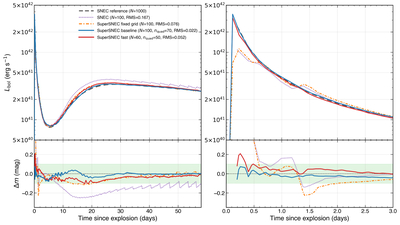
Caption: Figure 3.
Bolometric LC comparison of five configurations against a 1000-zone SNEC reference (black dashed line). Top panels: luminosity; bottom panels: magnitude residuals ﹩{\rm{\Delta }}m=-2.5{\mathrm{log}}_{10}(L/{L}_{{\rm{ref}}})﹩, with the green band marking ± 0.1 mag. Left: full evolution (0–58 days); right: early-time zoom (0–3 days). The original SNEC code at N = 100 (purple dotted; Δmall = 0.167 mag) diverges strongly at t ≲ 0.5 days and t ≳ 10 days. SuperSNEC with the same fixed computational grid (orange dotted–dashed) improves via adaptive 56Ni cadence and solver tuning. The adaptive-runtime grid brings a further factor-of-three improvement: the baseline (N = 100, nquad = 70; blue solid line) and fast (N = 60, nquad = 50; red solid line) configurations both remain well within 0.1 mag across all phases. The SuperSNEC fixed-grid model uses fNi = 0.10; the baseline uses fNi = 0.20, nquad = 70; the fast model uses fNi = 0.20, nquad = 50. All three share αsurf = 7, trelax = 5 days, ﹩{\rm{\Delta }}{t}_{{\rm{Ni}},{\rm{\min }}}=5\times 1{0}^{4}﹩ s, ﹩{\rm{\Delta }}{t}_{{\rm{Ni}},{\rm{\max }}}=5.456\times 1{0}^{5}﹩ s. The original SNEC uses ﹩{\rm{\Delta }}{t}_{{\rm{Ni}},{\rm{\min }}}=5\times 1{0}^{4}﹩ s with no adaptive cadence.
Other Images in This Article
Copyright and Terms & Conditions
© 2026. The Author(s). Published by the American Astronomical Society.

