Image Details

Choose export citation format:

CHIME/FRB Outriggers: Design Overview

  • Authors: Mandana Amiri, Bridget C. Andersen, Shion Andrew, Kevin Bandura, Mohit Bhardwaj, Kalyani Bhopi, Vadym Bidula, P. J. Boyle, Charanjot Brar, Mark Carlson, Tomas Cassanelli, Alyssa Cassity, Shami Chatterjee, Jean-François Cliche, Alice P. Curtin, Rachel Darlinger, David R. DeBoer, Matt Dobbs, Fengqiu Adam Dong, Gwendolyn Eadie, Emmanuel Fonseca, B. M. Gaensler, Nina Gusinskaia, Mark Halpern, Ian Hendricksen, Jason Hessels, Ronniy C. Joseph, Jane Kaczmarek, Victoria M. Kaspi, Kholoud Khairy, T. L. Landecker, Adam E. Lanman, Albert Wai Kit Lau, Mattias Lazda, Calvin Leung, Robert A. Main, Kiyoshi W. Masui, Ryan Mckinven, Juan Mena-Parra, Bradley W. Meyers, Daniele Michilli, Nikola Milutinovic, Kenzie Nimmo, Gavin Noble, Ayush Pandhi, Aaron B. Pearlman, Jeffrey B. Peterson, Emily Petroff, Ziggy Pleunis, Alexander W. Pollak, Masoud Rafiei-Ravandi, Andre Renard, Mawson W. Sammons, Ketan R. Sand, Pranav Sanghavi, Paul Scholz, Vishwangi Shah, Kaitlyn Shin, Seth R. Siegel, Andrew Siemion, Jonathan L. Sievers, Kendrick Smith, David Spear, Ingrid Stairs, Keith Vanderlinde, Haochen Wang, Jacob P. Willis, Tarik J. Zegmott

Mandana Amiri et al 2025 The Astrophysical Journal 993 .

  • Provider: AAS Journals

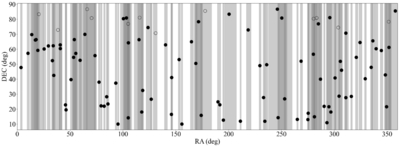
Caption: Figure 4.

Cartesian projection of the 97 pulsars that the CHIME/FRB Outriggers will use as calibrators (A. B. Pearlman 2024; A. P. Curtin et al. 2025, in preparation). Pulsars are shown with black circles, while the gray circles show the lower transits for the high-decl. pulsars. The width of the gray shaded area indicates the range of hour angles that the pulsar is observable by CHIME, which depends on the decl. of the source. Darker regions indicate that more than one pulsar is visible in the CHIME beam at the given time. Note that CHIME only sees the sky north of decl. −11°. Coordinates are J2000.

Other Images in This Article
Copyright and Terms & Conditions

Additional terms of reuse