

Image Details
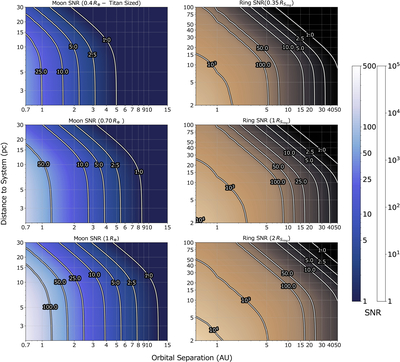
Caption: Figure 5.
Estimated SNR with HWO. The estimated SNR values for exomoon and exorings were calculated across a variety of ring/moon sizes, orbital separation (e.g., the distance from the star to the planet+moon or planet+ring), and system distances. The left column of three plots shows the SNR of exomoons of varying sizes from smallest (Titan radius) on the top to largest (Earth radius) on the bottom. The right column of three plots shows the SNR of exorings of varying sizes from smallest (B-ring radius) on the top to largest on the bottom (2× the radii of Saturn’s A through D ring, or ﹩2\times 1{R}_{{S}_{\mathrm{ring}}}﹩). The middle panel corresponds to Saturn-sized rings. Rings comparable to or larger than Saturn’s are detectable to 5 signal-to-noise ratio (S/N) across an impressively broad region of parameter space: they are detectable out to a = 5 au to distances of 100 pc, and at a = 25 au out to 20 pc. Additionally, Titan-sized moons with Triton-like geometric albedos are detectable at 5 S/N out to orbital separations of ∼2 au. Earth-sized moons with Triton-like geometric albedos are detectable out to ∼5.5 au for the closest systems.
Other Images in This Article
Copyright and Terms & Conditions
© 2026. The Author(s). Published by the American Astronomical Society.

