

Image Details
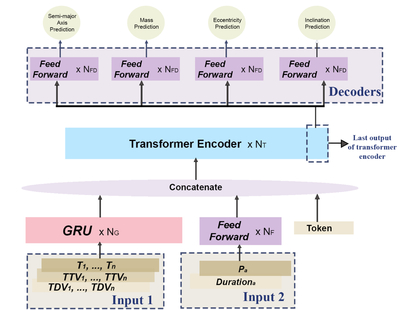
Caption: Figure 2.
Deep learning model architecture. NG and NF denote the number of layers of GRU and FF, respectively. NT is the number of layers of the transformer encoder. NFD is the number of FF layers in the decoders. Token is an extra input of the transformer encoder, which is initialized as a tensor with zeros. There are three model variants in this work: the model with TDV input and without noise, the model without TDV input and without noise, and the model without TDV input and with noise. The numbers of layers, hidden dimensions, and other hyperparameters differ among these variants, as described in Sections 2.3 and 3.1 and implemented in the released code. As a representative example, for the model with TDV input and without noise, Input 1 has dimension [64, 135, 3], corresponding to batch size, number of transit epochs, and the three input features: transit time, TTV, and TDV. Input 2 has dimension [64, 1, 2]. The GRU output has dimensions [64, 135, 256]. After concatenating the GRU output, the encoded Input 2 token, and an additional zero token, the Transformer output has dimension [64, 137, 256]. The final output dimension is [64, 4].
Other Images in This Article
Copyright and Terms & Conditions
© 2026. The Author(s). Published by the American Astronomical Society.

