

Image Details
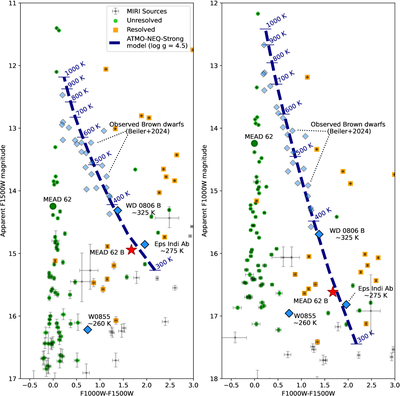
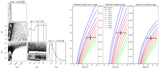
Caption: Figure 2.
Apparent F1500W (left) and F1000W (right) magnitudes vs. F1000W – F1500W colors for all sources detected in both filters at ≥10σ in the MIRI FOV for MEAD 62. MEAD 62 B is consistent with an ∼300 K brown dwarf when compared to an ATMO2020 evolutionary model in these CMDs. Individual catalog sources are in black. The resolved sources (galaxies) are tagged as orange squares, while unresolved point sources are assigned green circles. The MEAD 62 white dwarf is shown as a large green circle, while the candidate companion, MEAD 62 B, is denoted by the large red star symbol. The ATMO2020 evolutionary model track for ﹩\mathrm{log}g=4.5﹩ with strong chemical disequilibrium is overlaid as a navy blue dashed line for substellar objects ranging between 1000 and 300 K (M. W. Phillips et al. 2020). In addition, actual MIRI measurements of brown dwarfs in the same temperature range are plotted as pale blue diamonds and confirm that the ATMO2020 model can be trusted, especially at Teff ≤ 600 K (S. A. Beiler et al. 2024). Plotted as large blue diamonds are WD 0806–661 B, the sole Y-type brown dwarf associated with a white dwarf (K. L. Luhman et al. 2012); W0855, the coldest known brown dwarf (K. L. Luhman 2014; S. K. Leggett et al. 2021); and the 6.3 ± 0.6 MJup exoplanet Eps Ind Ab (E. C. Matthews et al. 2024). They represent the coldest objects with measured F1000W and F1500W magnitudes.
Other Images in This Article
Copyright and Terms & Conditions
© 2026. The Author(s). Published by the American Astronomical Society.

