

Image Details
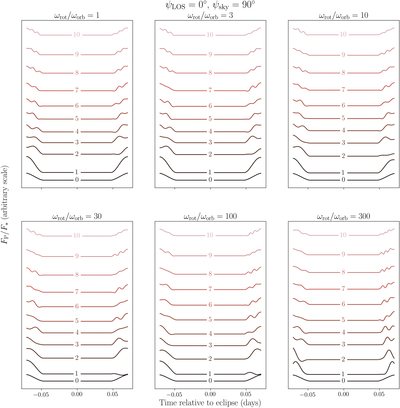
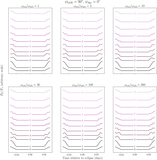
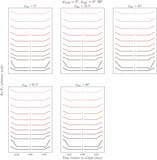
Caption: Figure 5.
The uniform brightness curve and the first 10 eigencurves with uniform components added for our Warm Jupiter model, at a range of rotation rates with ψ sky = 90°. Rotation rates span the scale from “slow” where the planet rotates a small fraction of a full rotation across eclipse (N tot < 1), to “fast” where the planet rotates through a considerable fraction of a full rotation. At the fastest rate the planet’s rotation period approaches the duration of ingress or egress (N i,e → 1). For reference, with our prototypical 10 day Warm Jupiter, N tot = 1 corresponds to ω rot/ω orb ≈ 71, and N i,e = 1 corresponds to ω rot/ω orb ≈ 432. One might notice that some eigencurves dip below the baseline where the planet is completely behind the star and contributes nothing to the observed flux. The eigencurves are initially generated from spherical harmonics, which each have zero net global brightness. Therefore, the eigencurves themselves start out as combinations of maps which each have zero net brightness. To “reconstitute” the eigencurves, we plot them here as additions on top of the uniform brightness curve. This allows for an eclipse curve composed of a single eigenmode to be unphysical, i.e., have net negative flux at some points.
Other Images in This Article
Show More
Copyright and Terms & Conditions
© 2022. The Author(s). Published by the American Astronomical Society.

