

Image Details
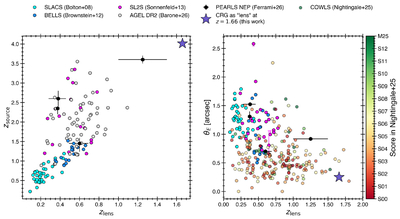
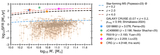
Caption: Figure 7.
Left: source vs. lens redshift for a sample of well-characterized, optically selected strong lensing systems (SLACS, BELLS, and SL2S; A. S. Bolton et al. 2008; J. R. Brownstein et al. 2012; A. Sonnenfeld et al. 2013, respectively) as compiled in C. Y. Tan et al. (2024), along with a recent release of strong lenses from the AGEL survey (T. M. Barone et al. 2026) and JWST-selected lenses in the PEARLS North Ecliptic Pole Time Domain Field (G. Ferrami et al. 2026). The lensing solution for the CRG is in excellent agreement with the existing parameter space for strong lenses. Right: Einstein radii for SLACS, BELLS, SL2S, PEARLS North Ecliptic Pole Time Domain Field, and over 400 candidate gravitationally lensed systems in the COWLS program (J. W. Nightingale et al. 2025). Assuming the CRG is not a lens, it cannot be distinguished from a selection in this parameter space, where it is similar to high-ranked and low-ranked lens candidates.
Other Images in This Article
Copyright and Terms & Conditions
© 2026. The Author(s). Published by the American Astronomical Society.

