

Image Details
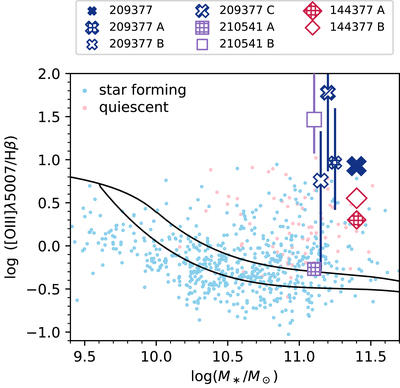
Caption: Figure 7.
The [O III]λ5007/Hβ flux ratios and stellar masses of each emission component of post-starburst galaxies. For LEGA-C 209377, the sum of components is also plotted. The shapes of markers represent different galaxies, and the open, filled, and hashed symbols are different kinematic components in a galaxy. The stellar masses of LEGA-C 209377 are shifted by hand for the presentation. Black lines separate galaxies dominated by star-forming regions (bottom) from AGNs (top), as well as the mixed region in between (Juneau et al. 2014). Small dots are other LEGA-C galaxies where the flux ratios can be measured. Blue and red represent star-forming and quiescent galaxies, respectively. All kinematic components in post-starburst galaxies except LEGA-C 210541 A have among the highest [O III]λ5007/Hβ for galaxies of similar stellar masses, suggesting that the AGN is the source of the ionization.
Other Images in This Article
Show More
Copyright and Terms & Conditions
© 2023. The Author(s). Published by the American Astronomical Society.

