

Image Details
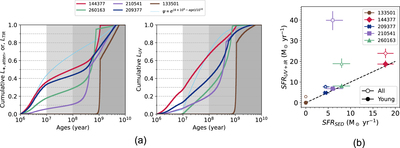
Caption: Figure 10.
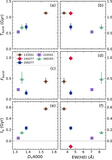
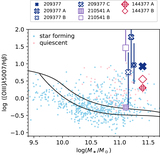
(a) The cumulative distribution of attenuated stellar radiation and UV luminosities as a function of stellar ages of post-starburst galaxies. The curves are calculated based on the best-fit SFHs and dust attenuation. The attenuated light then re-emitted in the IR. About 70% of the L TIR of a star-forming galaxy (light blue) is heated by stars younger than 100 Myr. The contribution from stars of <100 Myr can be much lower in post-starburst galaxies. Similarly, a larger fraction of the UV radiation of post-starburst galaxies is contributed by older stars compared to star-forming galaxies. The radiation from old stars results in overestimates of SFRs based on FIR and UV luminosities. (b) The contamination from old stars to the SFRUV+IR. The filled symbols show the SFRUV+IR after excluding the contribution from stars older than 100 Myr (see the main text). The new SFRs are much lower than original SFRUV+IR and more consistent with SFRSED.
Other Images in This Article
Show More
Copyright and Terms & Conditions
© 2023. The Author(s). Published by the American Astronomical Society.

