

Image Details
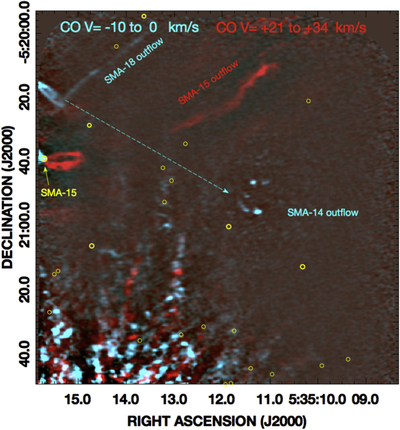
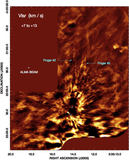
Caption: Figure 11.
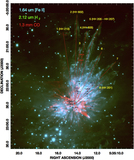
Image showing the CO emission at VLSR = −10 to 0 km s−1 in cyan and +21 to +34 km s−1 in red in the region containing the north and northwest fingers. The yellow circles mark compact (unresolved) 1.3 mm continuum sources. Some can be identified with stars in visual or near-IR images; others, such as SMA-15 (Teixeira et al. 2016) have no visual or near-IR counterparts. The outflows unrelated to OMC1 are indicated. SMA-15 drives a bipolar flow with a redshfted lobe deflected toward the north. The blueshifted limb-brightened cavity marks an outflow, possibly originating form SMA-14 in Teixeira et al. (2016). This flow appears to terminate in the compact knots just east of the label “SMA-14 outflow.” These knots are associated with a southwest-facing bow shock in H2 that is also an HH object. Finally, the highly collimated blueshifted filament labeled “SMA-18 outflow” traces a jet, possibly from SMA 18 in Teixeira et al. (2016). These flows are described in the text.
Other Images in This Article
Show More
Copyright and Terms & Conditions
© 2017. The American Astronomical Society. All rights reserved.

