

Image Details
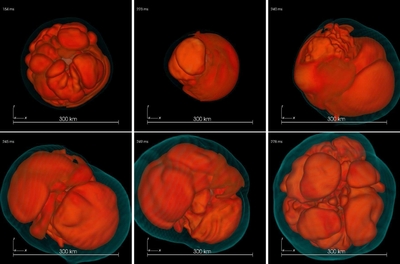
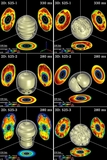
Caption: Figure 1.
Snapshots of phases with convective and SASI activity in the evolution of the 27 M ☉ model at 154 ms, 223 ms, 240 ms (upper panels, from left to right), 245 ms, 249 ms, and 278 ms (lower panels, from left to right). The volume rendering visualizes surfaces of constant entropy: The outer, bluish, semi-transparent surface is the supernova shock, the red surfaces are entropy structures in the postshock region. The upper left panel displays mushroom-like plumes of expanding, high-entropy matter that are typical of neutrino-driven buoyancy. The upper middle and right plots and the lower left and middle panels show distinctly different entropy structures of dipolar (and quadrupolar) asymmetry, which engulf the still visible buoyant plumes with their higher-order spherical harmonics mode pattern. The entropy asymmetries of ℓ = 1, 2 character are caused by global shock sloshing motions, which create hemispheric high-entropy shells in phases of shock expansion. At 223 ms and 240 ms the shock has pushed toward the lower right corner of the panels whereas at 245 ms and 249 ms it is in a phase of violent expansion motion toward the upper left corner of the plots. All stages exhibit a strong deformation of the shock. At 278 ms the vivid SASI phase is over, the shock is more spherical again, and the postshock entropy structures correspond to neutrino-driven plumes.
(Animations (1a and 1b) of this figure are available in the online journal.)
Other Images in This Article
Copyright and Terms & Conditions
© 2013. The American Astronomical Society. All rights reserved.

